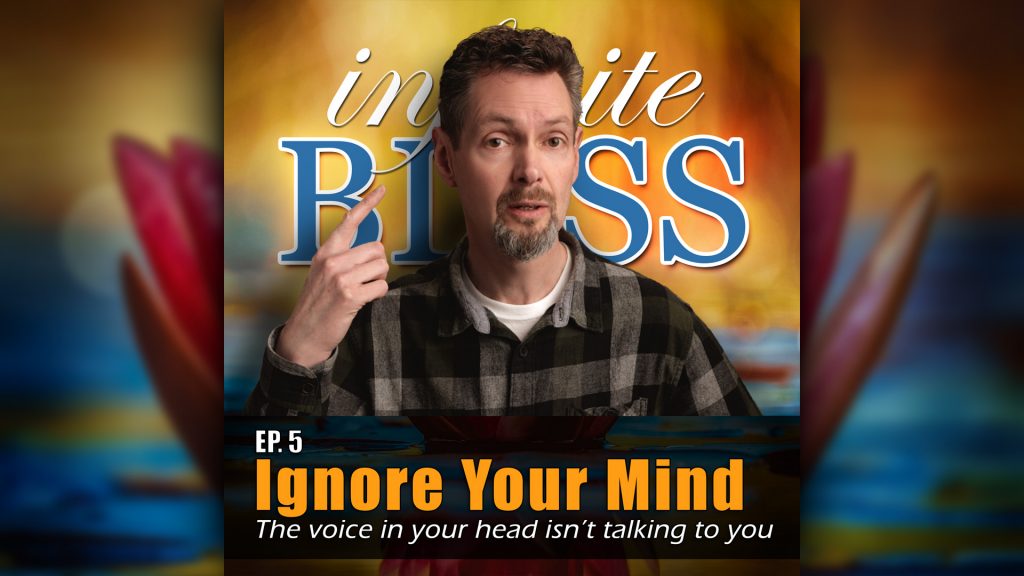
Infinite Bliss Podcast – Episode 5
This alternative view of what the mind is doing when you “think” it’s talking to you is incredibly eye opening. You’ll view that voice in your head very differently after listening to this episode and will be able to take back control and step away from the drama. That pesky voice in your head is never talking to you. Listen now to find out why.
A lot of people ask, why does our mind talk to us. It’s a fairly common question. Through my awakening process I was able to observe the mind when it feels superior as well as when it feels inferior. I also got to spend a couple of years with a completely silent mind. But the real, ahaaaaaa, moment came when that voice in my head slowly started talking again.
Then it became plain to see that our mind is reacting to the world around us simply looking for our advantage. What makes us superior. But underneath all this, is the fear that triggers that response.
This episode of the Infinite Bliss podcast unravels this mystery by providing a very simple, thought provoking theory.
Thanks for listening my friends.
Mat Robinson ~ The Gregarious Hermit

Use the embedded player above or click here to play this episode directly on Spotify
Also available on, Apple Music, Amazon Music as well as Youtube Music and Youtube videos. Plus wherever else you get your podcasts. Click here for a full list of all streaming platforms you can find Infinite Bliss


Transcript
You’re listening to the Infinite Bliss Podcast. I’m your host, Mat Robinson, the Gregarious Hermit. Join me each week as I take you on a journey of inner exploration to uncover the subtle connections between mind, body and spirit. I want to teach you how to regain control of your mind so you can let go of the drama in your life and experience deep inner-peace and infinite bliss.
Hey there. Welcome and thank you for joining me. Today is my birthday and I would love to share a gift with you. I want to convince you that you are never talking to yourself and that it’s completely safe to ignore that voice in your head.
Once you understand my reasoning, you can start to view your mind very differently. You’ll be able to regain control and get rid of all the drama.
And just to be clear, I’m not a trained psychologist, and you’re definitely not going to find this written in any psychology books or journals. At least not yet. But I am hoping to change that.
But this alternative theory is at the root of a lot of mental health issues that people face, such as anxiety, depression, feelings of loneliness, and pretty much any mental health issue that isn’t neurological or physiological in nature. These are all issues related to circumstance and how your mind interprets that.
What I’m going to be talking about is just my personal opinion and comes directly from my awakening experience, where I was able to witness the mind feeling superior, feeling inferior, and then becoming completely silent for a period. But the ahaaaaa moment came when it slowly started talking to me again. And that’s when the understanding and the realization that it’s simply reacting to the world around us and preparing conversations to have with other people.
If you missed the first episode of this podcast, then I highly encourage you to go back and listen to episode one so you can learn about my epic rollercoaster ride.
Why Would Your Mind Talk to You?
Okay, so enough about me and my ego. Let’s get started. So why would your mind talk to you? It doesn’t seem to make much sense if you think about it.
Speaking is such a slow means of communication, it’s clunky and imperfect. If I tried to describe the Eiffel Tower to somebody who’s never seen it before, I’d have to describe so many abstract concepts, shapes, sizes, colors, textures, materials, purpose. And I bet the person listening to my description would be envisioning something nothing like I was describing.
All those words and all that time. And yet I could show them a picture of the Eiffel Tower and understanding all those concepts is almost instantaneous. Barely any time at all.
A picture really is worth a thousand words, or maybe even 10,000.
Speed of Thought vs. Speed of Words
Okay, so that’s describing something to somebody else. But maybe that’s not a good example. But what do you think life would look like if this mind-body system of ours operated at the speed of words?
Let’s say you’re driving along and someone steps out in front of you. Imagine if you had to listen to a conversation in your head before reacting. “Oh, boy. Someone just stepped in front of the car. Maybe you should hit the brake pedal.” I think the traffic accident statistics would speak for themselves.
Mountain bikers would never make it past the first tree without crashing and table tennis players would never be able to return their opponents serve. I think chess players would be okay. But what about jugglers and musicians? Each musical note laboriously choreographed with inner verbal instructions.
We operate instinctively at the speed of thought, not the speed of words. Thought is instantaneous, but words are slow and clunky.
Not that I condone violence of any kind, but if somebody tried to punch me, even without any martial arts training, my hands would instinctively reach up to try to block the attack without a single syllable entering my head.
If I had to wait for my mind to finish saying, “Oh, looks like he’s swinging his first at you, you’d better move your arm up to block the punch.” I’d get punched in the face before my mind could finish the first word, let alone the whole sentence. Speaking is just way too slow.
If you’re still not sure if your mind is talking to you, how about this?
We’re not born understanding language. It’s not an innate part of being human. Do you think that people who are born deaf have a voice in their head? Their mind doesn’t communicate with them using language. And what about the many different languages we have on the planet? Are minds preprogramed to understand languages? No, it’s a learned skill. I don’t dream in Spanish or German because I don’t know those languages.
So it doesn’t make sense to me why we think that our minds are talking to us.
If you lived in a society where language hadn’t been invented yet and people just pointed at the things they wanted. Do you think you would have a voice in your head then?
So do you really think that your mind is relaying vital information to you in this slow, clunky, non-human way?
And think about this. If you’re talking to yourself, surely you already know what you’re going to say. So just let that sink in for a moment. If you’re talking to yourself, surely you already know what you’re going to say.
That alone should be enough to convince you that there is no need for your mind to talk to you.
Talking is just too slow, too inefficient, too clumsy and imprecise. So there’s no way on earth that your mind would try to give you instructions, directions or commands using language.
Why Do I Have a Voice in My Head?
So the next question we need to ask ourselves is this. If my mind isn’t talking to me, why then do I hear that voice in my head?
And just a reminder, I’m not a psychologist. This is just my opinion, formed by my own experiences of life and one very bizarre experience. But here goes.
I think we can all agree that language is only needed to communicate with other people. It’s a way to share concepts and ideas. It’s a way for me to convert a vision in my head into a string of words that then allow you to build that same vision in your head.
So if I describe the Eiffel Tower that I see in my mind in enough detail, then you will start to mentally reconstruct the Eiffel Tower in your mind. Our two images are not going to match. But hopefully it’s enough for us to understand each other.
The Coffee Shop
Let me give you an example and try to pay close attention to what your mind does as I’m talking.
“I was at the coffee shop the other day drinking a hot mocha frappe latte. I was sitting in a cozy nook by a beautiful potted plant. There was sunlight pouring through the window and making the room glow a beautiful warm color. The smell of fresh roasted coffee filled the place with a wonderful aroma. And there was a gentle hum of conversation in the background.”
Okay, if it’s not obvious from that story, I don’t go to coffee shops often. I just wanted you to think I was cool and relatable.
But hopefully as I was speaking, you noticed what was going on. As you listened to my story, your mind kept flashing pictures of all the things I described and building a mental image of where I was.
These flashes of images are so fast you barely, if ever notice them. That’s the speed of thought, not the speed of words. And if you’re a keen coffee shop frequenter, you might have heard your mind say something like, “Hey, wait a minute. A hot frappé. That’s an oxymoron. This guy’s an idiot.” If you did awesome, well done. You win a small victory over me. And in a little while, you’ll understand why your mind did that.
I’m digressing a little. But let’s go back to my coffee shop example.
Inside my own mind, I could see my vision of the coffee shop fully formed, almost like I was watching a movie. But then I had to describe the scene to you in super slow, clunky vision.
And even then I didn’t get to describe the color of the walls, the conversations, the people’s faces and clothing, the sugar packets, the coffee stains, plus millions of other details that I could see but would take forever to describe. Not to mention, all the people that kept handing me tons of money. It was my daydream, after all.
But the thing to note is the words are just a way for us to communicate with each other, not with ourselves.
Your mind is simply practicing conversations to have with other people.
So that brings us to the next question. If our minds aren’t talking to us, why are they always rehearsing conversations with other people? Why on earth would they do that?
I’m a Survivor
One of the primary tasks of the mind is to keep us alive, to keep us safe from harm so we can evolve as a species.
Because of this, the mind is very reactive to the world around us. It’s always scanning your surroundings, looking for trouble and identifying threats. That’s why you get startled by sudden sounds and movement in your peripheral vision catches your attention. Your physiology is wired to keep an eye out for danger.
So when your mind perceives a potential threat, it will start to come up with a defensive strategy. It tries to figure out what would give you an advantage over the threat just in case the threat actually materializes.
If I saw a bull that looked like it was about to charge towards me, I would be looking for a tree to climb or a wall to jump over. Just in case.
If it looked like it was going to rain as I was leaving the house, I would grab an umbrella or a raincoat. Just in case.
If I was walking down the street and saw somebody that looked like they might want to start a fight. I would be assessing whether I could easily fight back, looking for a big stick or getting ready to run away. Just in case.
If I thought I was going to get into an argument with someone, then my mind would figure out the best thing to say to confront the person. Just in case.
Ahhaaaaaaa, so now do you see what might be going on? We don’t face the same kind of physical threats that our ancestors used to. Our modern landscape is very different.
We’re NOT Cavemen Anymore
I’m not afraid of being chased by a tiger anymore, but I am afraid of what other people might be thinking about me. My mind isn’t afraid of physical threats so much these days, but it is wary of interaction and conflicts with others that might lead to a confrontation.
I’ve got to be honest with you. I’ve never walked out of my front door and been afraid I’d be eaten by a lion because I’ve never experienced that as a threat. But I am afraid of conflict and confrontation because those are very real things that have actually happened to me.
For most of us, these things happen as children. People laugh at you, make fun of you, say mean things to you. We get into arguments and disputes on the playground.
They are verbal assaults and made you feel uncomfortable. Maybe it caught you so off guard that you couldn’t think of the right thing to say in response. You felt defeated like the other person got the better of you.
And so your mind says, “Well, that sucked. I must safeguard myself against similar attacks in the future. I have to survive in order to evolve the species.”
Okay, so maybe equating survival of the species and devising strategies to defeat a playground bully is a bit dramatic. But for our very primitive mind, it doesn’t know the difference.
If you were constantly being attacked by flying squirrels armed with baseball bats, your mind would be so preoccupied with scanning the trees, looking for danger that you wouldn’t even notice if somebody said something mean to you.
Our World is Mental
Whatever is the biggest danger in your life, your mind will constantly be on the lookout for it.
But it seems that our world has become full of mental dangers. Social interactions are littered with landmines, and there isn’t a single person on the planet that hasn’t been offended by something somebody said.
So your mind has learned to fear interactions with other people and seems to constantly want to prepare conversations. Just in case.
When we talk with someone in real time, we don’t have to constantly say, “Hold on a minute while I listen to what my mind wants me to say.” And then you stand there with an hourglass spinning in your eyes while you listen to that voice in your head.
The words just come out in real time. But that’s when we say the wrong thing, get tongue tied or can’t figure out what to say. We make mistakes and it makes us feel awkward and our mind feels vulnerable. And that’s where this fear of interaction comes from.
My mind has learned to fear not knowing what to say just because of some past awkwardness or a hostile confrontation. But now my mind wants to avoid it, even if I’m not aware of it.
I’m not going to get attacked by a saber tooth tiger, but I am likely to get into a yelling match. It’s something that has happened to all of us. Kids say the meanest things to each other, and this is where fear of confrontation and self-talk starts.
Interactions with other people cause most of my problems these days. They cause the most constant fear in my mind, closely followed by flying squirrels with baseball bats.
And just to be clear, when I say fear, I don’t mean like you’re cowering in the corner with your hands over your ears, but your mind is wary. It’s always looking for danger. There’s fear there, even if we don’t recognize it as such.
Morgan Freeman to the Rescue
So whenever you hear that voice in your head, your mind is just envisioning and interaction with somebody and preemptively testing a sentence. The conversations it creates are just “what ifs.” It’s rehearsing what we would say. So naturally it’s going to sound like our voice. And because it sounds like us, we think it’s us talking. So we listen.
If that voice in my head sounded like Morgan Freeman, it would be pretty obvious that it wasn’t me talking to myself. But instead I’ve got this doofy British voice rattling around up there.
Environmental Dangers
If I switch environments, the list of things I’m fearful of changes. When I’m in the woods, my mind will keep an eye out for rotten trees that could fall on my head. Bears, mountain lions and of course, flying squirrels with baseball bats.
But when I’m out walking around town, my mind will be wary of other people because I’ve had conflicts with people in the past.
If I’m driving, my mind will be wary of other cars because those darn things keep cutting me off.
So your environment, your upbringing and your childhood experiences shape a lot of this stuff.
Now just think about how mean and judgmental our society has become since the advent of social media. When I was growing up, people had to physically get in your face to say something mean to you. Now I can get socked over the head by a social media comment from somebody halfway around the world.
My comments that at one time would be limited to the people within earshot are now potentially heard by 8 billion opinionated people.
And do you think that all of them will agree with my ideas? No, of course not. So in our modern age of connectedness, at least one of those people will feel brave enough to criticize me from behind the anonymity of cyber land.
It makes them feel good. It makes them feel superior. Proving my point yet again.
The Internet has emboldened and enabled this era of judgment and criticism, but it will only affect you if you start to listen to and react to that voice in your own head.
Somebody could tell me that I’m stupid or doofy looking to my face, but I only get angry, upset or defensive if I listen to how my mind prepares a defense on my behalf. There’s no real danger there. Sticks and stones.
If I just let the thought pass, there is no reaction in my body and I retain my inner peace and tranquility.
3 Types of Self-Talk
There seems to be three different forms of self-talk that stem from this primitive threat avoidance mechanism.
You might notice that you spend a lot of time criticizing other people. Whatever you just said in your mind makes you superior. It makes your mind feel safe because it figured out your advantage.
You might also notice your mind defending or justifying your own actions, things that you would normally criticize other people for doing. If you’re guilty of doing them yourself, you might notice that your mind comes up with a really good excuse. My mind feels safe because it has a good solid defensive argument prepared.
And then my favorite, and I’m guilty of this a lot. Narrating your life like you’re explaining to a friend the best way to do something or explaining why you’re doing something the way you’re doing it. So it might sound pretty innocent, but again, your mind is fearing judgment, somebody telling you that you’re doing it wrong. And so it’s demonstrating your superiority by preparing a conversation for an imaginary person.
It is interesting that you never hear the criticism from the other person. The thing that your mind fears. All you hear is the response that your mind prepares. And I think that’s why we get the misunderstanding that we’re talking to ourselves rather than just hearing the mind get suited up with armor ready for battle.
The criticism is one of those instantaneous flashes I mentioned earlier that works at the speed of thought. But then you hear your mind slowly and clumsily piecing together a suitable response.
Attacking My Neighbors – Defending Against My Neighbors
Here’s a funny story to illustrate the point. After my mind started talking to me again, I noticed something strange when I was mowing the lawn. I have an average lawn. It’s not pretty. A few dandelions here and there, but I always mow it every week so it looks mediocre at best.
I have two neighbors. One who is so meticulous and seems to clip his grass precisely with a pair of scissors. Not a single weed. You know the type. And then my other neighbor that can’t keep on top of his lawn for health reasons and he can’t afford to pay for a weekly lawn service.
So as I was mowing my adequate, mediocre lawn towards my one neighbor’s good lawn, I would hear my mind get defensive. I wouldn’t hear my neighbors say, “you should mow your lawn more often”, but I would hear things like, “well, at least I don’t use chemicals to kill the weeds. They’re bad for the environment.” Or, “I can’t believe how much time you spend doing your yard work. Wouldn’t you rather go out and have fun?” Just finding some excuse to feel superior to the guy with the, very obviously superior, lawn maintenance skills?
And then I would get to the end of the row, turn around and head back towards my other neighbors lawn. Now, all of a sudden, I’m feeling superior for real. “I can’t believe you let your lawn go for so long without mowing. What’s wrong with you?” Besides the obvious ill health and financial issues. But my mind doesn’t care.
It just preps an argument in case my neighbor comes out and we start talking.
And I’d also slip into narration quite a bit just to prove that I knew how to take care of a lawn. So I would hear things like, “now, as you get to the end of the row, you want to slow down, lift the front slightly and pivot on the inside wheel, but not so much that all the grass clippings fly out from under the lawnmower.” I’d also be talking about how to line the wheels up with the previous edge.
But being able to just sit back and chuckle as my mind alternately attacked and defended my neighbors was really amusing.
It’s a funny but relatable example, and it really shows just how fragile and fearful our mind is. Our delicate ego. Always making comments to feel superior, but hiding subtle fears.
So just start to pay attention to your thoughts and notice things like that. If you look for it, you’ll start to see the insecurity and the fear that lurks beneath that thin veil of superiority. My mind is just fending off potential judgments with counterattacks or excuses or preemptively judging just to feel safe.
The other thing to notice with all this self-talk is that you’re the only one that hears it. You rarely, if ever, say the words out loud.
I would never dare tell my neighbors those thoughts. I’d compliment my neighbor with the good lawn and I’d commiserate and have sympathy for my neighbor’s poor health. So I’m the only one that hears those comments. It’s just a complete waste of time.
Self Criticism – I don’t think so
Now, I know this is dragging on a little bit, but I’d love to share one more story with you.
I did a clinic on this subject a while ago, and one woman in the audience was adamant that her mind was really mean to her and definitely talked to her. She was so convinced. So I asked her if she could give me an example. She said when she spills something or drops something on the floor, her mind always says how stupid she is.
So I said, “How does your mind say it exactly?” It says, “I’m so stupid. I can’t believe I’m so clumsy.” So I said, “If there was someone standing next to you when you spilled your drink, would you say that out loud?” Ahaaaaaaa. So your mind is rehearsing what you would normally say if someone else was standing there.
Now, self-criticism like that is quite interesting. We often verbalize self-criticism in front of other people as a learned defensive measure.
If I jump in and criticize myself, then other people usually offer sympathy, not criticism. If you criticize yourself first, nobody else can. You beat them to the punch. So you effectively disarm everyone. Wow. What a great way to avoid conflict.
So even though it might sound like you’re criticizing yourself, you’re not.
You’re just listening to your mind’s air bags going off to protect you from imminent danger.
Summary of why it’s safe to ignore that voice in your head
Okay. I’m going to wrap it up here. There’s a lot more we can talk about, but I feel like this is a good breaking point for now.
It’s important to start to notice your thoughts, but try not to react to them. Listen to them like you’re listening to someone else talking rather than your mind giving you instructions.
Recognize that, only you hear that voice in your head. Only you. And also recognize that, while you’re ranting in your head, it doesn’t change anything going on in the world around you. All it does is take you away from enjoying the physical world, and instead drags you into some drama.
I spent almost two years with a completely silent mind, and I can reassure you that nothing changes about your reality.
You will still be able to function as a human being. In fact, you’ll be able to function much better because you won’t constantly be dragged off on some mind based side quest.
You’ll enjoy all that life has to offer the ups as well as the downs, because your mind won’t be criticizing and complaining.
Create a little separation between you and your mind so you can start to see that you are not the mind, that you are not those thoughts in your head.
But here’s the main conclusion. You are never talking to yourself. Your mind is just prepping conversations to have with other people. It’s just looking for trouble and prepping some words of protection ahead of time. Just in case. Whenever you hear that voice in your head, just ask yourself if you’re attacking, defending or narrating. Give the thought one of those labels and then just let it go.
Even innocent sounding conversations you’re having with a friend in your head. Your mind is just fearing you screwing up. You don’t need it. Trust me. The conversation in your head doesn’t serve any purpose.
So now you know that it’s perfectly safe to ignore those conversations. You can give yourself permission to stop listening and remain present. And once you stop reacting to the thoughts, once you stop getting emotional about them, what will happen over time is that your mind realizes that you’re not afraid of the things it’s trying to warn you about. And so it stops trying to alert you to all this fake danger.
Your mind becomes less reactive. Becomes calmer. And that’s when you start to experience deep inner-peace and infinite bliss.
Did I do a good enough job convincing you? If not, get out there and try to see what I’ve been talking about so you can convince yourself.
All right. Thank you so much for listening. Don’t forget to like and subscribe and also tell your friends. The simple understanding of what your mind is actually doing when you think it’s talking to you. Could really help someone out there who is struggling with their own mental health.
We could start a revolution with this new way of looking at that annoying voice in our heads.
Oh, hold on a second…………. Okay. My mind wanted me to tell you that it feels superior to you. And thanks for listening. I’ll catch you on the next episode.
Bye.
If you enjoyed this episode of the “Infinite Bliss” podcast, then please consider feeding the hermit by visiting “Buy Me a Coffee” and donating. Every penny is greatly appreciated and accepted with gratitude and thanks.

Got a Question?
I love hearing from my listeners. If you have an interesting question or story that you think other listeners might like to hear, just fill out the form below and let me know.